
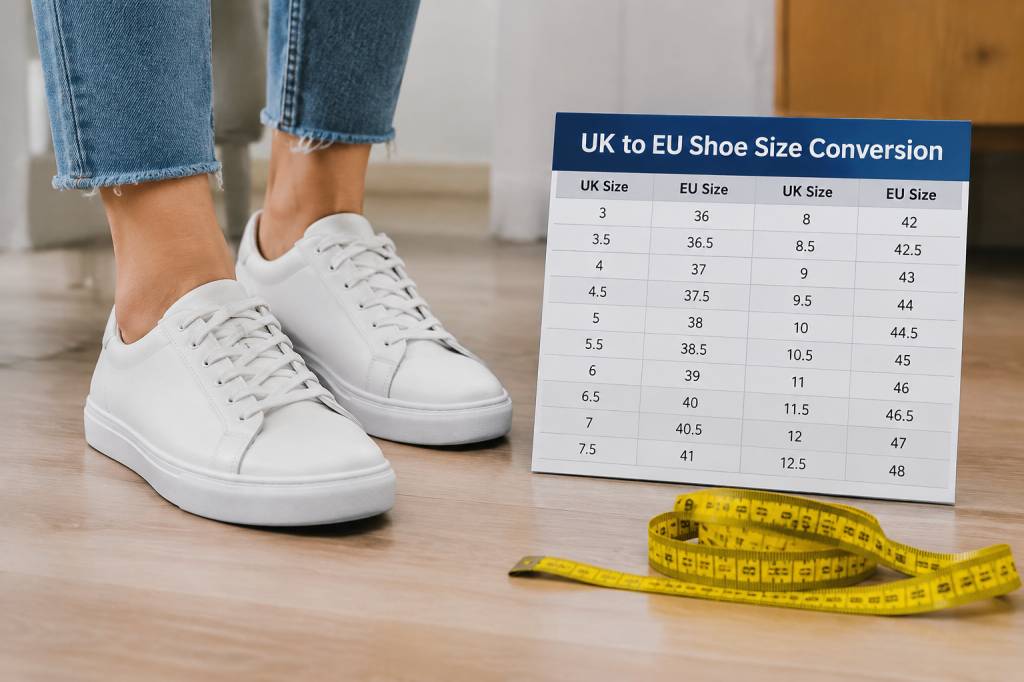
Buying shoes online should be simple: choose your usual size, add to basket and wait for the delivery. Yet UK and EU sizing systems do not line up perfectly, and a UK 10.5 can translate differently depending on the brand, shoe type and intended fit. If you are searching for a 10.5 UK to EU shoe size conversion, the closest general match is usually EU 45.
That said, EU 45 is a starting point rather than an absolute rule. Some brands list a UK 10.5 as EU 44.5, 45, or 45.5, while certain trainers may feel more generous than formal shoes in the same nominal size. This guide explains the most reliable way to convert your size, check the fit and avoid an expensive return.
What is a UK 10.5 in EU shoe sizing?
In most men’s and unisex footwear, a UK size 10.5 converts to approximately EU 45. Depending on the manufacturer, you may also see EU 44.5 or EU 45.5 shown on the product page.
- UK 10.5: the size used by most British retailers
- Approximate EU equivalent: EU 45
- Possible brand variations: EU 44.5 to EU 45.5
- Approximate foot length: around 28.5–29 cm, depending on the sizing chart
Unlike UK sizes, which follow a traditional barleycorn-based scale, EU sizes are generally calculated using a different measurement system called the Paris point. One EU size represents approximately 6.67 mm, but brands can apply the system with slightly different allowances for toe room, lining and overall shape.
This is why two pairs marked EU 45 may not fit identically. Shoe sizing is not quite as precise as the label suggests—particularly when comparing running shoes, leather brogues, hiking boots and fashion trainers.
Quick UK 10.5 to EU conversion chart
The table below offers a practical reference when shopping across UK and European websites.
- UK 9: approximately EU 43
- UK 9.5: approximately EU 44
- UK 10: approximately EU 44.5
- UK 10.5: approximately EU 45
- UK 11: approximately EU 45.5–46
- UK 11.5: approximately EU 46.5
- UK 12: approximately EU 47
Use this chart to narrow down your choice, but always check the individual retailer’s conversion table before ordering. If the product page says that UK 10.5 equals EU 44.5, follow that brand’s information rather than relying solely on a general chart.
Is UK 10.5 the same for men and women?
A UK 10.5 usually refers to a men’s or unisex size. Women’s footwear uses the same UK numerical scale in many British shops, but the shape and width of the shoe may be different. A women’s UK 10.5 may therefore be labelled around EU 44.5 or EU 45, while a men’s or unisex model may be listed as EU 45 or EU 46.
The number alone does not tell you everything. Women’s shoes are often designed with a narrower heel and a different forefoot shape, while men’s shoes may offer a wider standard fit. Some brands also use separate women’s and men’s conversion charts, even when the length is similar.
When shopping for a women’s style in UK 10.5, look for:
- The brand’s women’s size chart rather than a general unisex chart
- Foot-length measurements in centimetres or millimetres
- Width options such as narrow, standard or wide
- Reviews mentioning whether the shoe runs small or large
Why EU 45 can fit differently between brands
There is no single worldwide standard that forces every brand to make an identical EU 45. Manufacturers interpret sizing systems through their own lasts—the moulds used to construct shoes. A narrow last may make an EU 45 feel shorter or tighter, while a wide, rounded trainer may offer more usable space.
Materials also affect the fit. Leather boots can soften and mould slightly around the foot, but they should not feel painfully tight when first tried on. Running shoes often include extra space at the front to accommodate foot movement, while dress shoes may have a sharper toe box that reduces the available room.
Common reasons an EU 45 may not feel like your expected UK 10.5 include:
- The shoe is built on a narrow or pointed last
- The brand’s conversion chart rounds sizes differently
- The model is designed to fit snugly for performance
- The shoe has a thick lining or removable insole
- Your feet have changed width or volume since your last purchase
- You are comparing a men’s, women’s and unisex design
In other words, the label gets you close, but the product details determine whether the shoe is genuinely comfortable.
How to measure your feet at home
Measuring your feet is one of the most useful steps when buying a UK 10.5 shoe online. You only need paper, a pencil, a ruler or tape measure, and the socks you expect to wear with the shoes.
- Place a sheet of paper on a hard floor, with one edge against a wall.
- Stand on the paper with your heel gently touching the wall.
- Ask someone to mark the end of your longest toe. Do not assume it is always the big toe.
- Measure from the wall edge to the furthest mark in centimetres.
- Repeat the process for the other foot.
- Use the measurement of the larger foot when checking the brand’s chart.
Measure both feet later in the day if possible. Feet commonly swell slightly after walking or standing, so an evening measurement can provide a more realistic guide than a measurement taken first thing in the morning.
Do not press the pencil against your foot at an angle, as this can make the measurement appear shorter. Stand naturally and keep your weight evenly distributed. A few millimetres can make a noticeable difference in a formal shoe or hiking boot.
How much space should you have in the toe box?
For everyday shoes and trainers, aim for approximately 8–12 mm of space between your longest toe and the front of the shoe. Your toes should be able to move comfortably without touching the end when you walk downhill or stop suddenly.
A little extra room is particularly important for:
- Walking shoes and running trainers
- Hiking boots worn with thicker socks
- Winter boots with insulated linings
- Work shoes worn for long shifts
- Travel shoes used for extended periods
Too much space is not ideal either. If your heel lifts significantly or your foot slides forward, the shoe may cause blisters and reduce stability. The best fit feels secure around the heel and midfoot while allowing natural movement at the toes.
Here is a useful test: walk around on a hard floor wearing the socks you plan to use. Bend your knees, climb a step if possible and check whether your toes touch the front. If the shoe feels tight immediately, it is unlikely to become comfortable simply because the label is your usual size.
UK 10.5 to EU sizing by shoe type
Trainers and running shoes
A UK 10.5 running shoe is commonly listed as EU 45, although some performance brands use EU 45.5. Running shoes should not feel compressed at the toes, especially if you are buying a model for longer distances. Check the brand’s measurement in centimetres and compare it with your larger-foot measurement.
If you are between sizes, a half-size increase may be useful in running footwear, but this depends on the model’s internal shape. Do not size up automatically if the shoe already has a generous fit.
Formal shoes and loafers
Formal shoes often have less flexible uppers and narrower toe boxes. UK 10.5 will usually convert to EU 45, but the shape of the toe can make the shoe feel smaller than a trainer marked EU 45. A rounded or almond-shaped toe is generally more forgiving than a pointed design.
For leather shoes, focus on heel security and width rather than expecting the material to stretch dramatically in length. Leather may soften, but it will not reliably create extra toe room.
Hiking boots
Hiking boots in UK 10.5 are often shown as EU 45 or EU 45.5. Try them with the socks you will use outdoors. If you regularly walk steep descents, check that your toes do not hit the front when the heel is locked into place with the laces.
Some walkers choose a slightly larger hiking boot to accommodate thick socks and foot swelling, but the heel must remain stable. A loose heel can create friction even when the length appears correct.
Football boots and performance footwear
Football boots and court shoes are commonly designed for a close fit. An EU 45 may feel snugger than an everyday trainer in UK 10.5. However, tight should not mean painful or cramped. Pay close attention to width, upper material and the brand’s advice about whether the model runs small.
What to do when the retailer lists different conversions
It is normal to find conflicting information. One retailer may list UK 10.5 as EU 45, while another lists EU 44.5. Rather than choosing based on the larger number, use this order of preference:
- Check the manufacturer’s official size chart.
- Compare the listed foot length in centimetres.
- Read customer reviews for comments about sizing and width.
- Check whether the product is a men’s, women’s or unisex model.
- Review the returns policy before placing the order.
Centimetre measurements are usually more useful than the EU number because they provide a direct reference to foot length. Still, the measurement may refer to the recommended foot length or the internal shoe length, so read the chart notes carefully.
Common mistakes when ordering a UK 10.5 online
The most common error is assuming that every brand uses the same conversion. Another is measuring only one foot or checking the size while sitting down. Both can result in a shoe that looks correct on paper but feels uncomfortable after an hour.
- Do not convert from UK to EU using a random online chart without checking the brand.
- Do not ignore width if your toes feel squeezed.
- Do not choose a smaller size to compensate for a shoe that is too wide.
- Do not rely on the size printed inside an old pair from a different brand.
- Do not remove tags or wear outdoor shoes extensively until you are certain about the fit.
If you are ordering from an EU retailer, remember that the listed EU size may be the only size shown, with no UK equivalent. For a typical UK 10.5, begin by checking EU 45, then compare the foot-length information and reviews before buying.
The practical answer: which EU size should you choose?
For most shoppers, UK 10.5 is approximately EU 45. Use EU 45 as your first option for trainers, casual shoes and many men’s or unisex styles. Consider EU 44.5 if the brand runs large or the model has a roomy fit. Consider EU 45.5 if the brand runs small, the shoe is narrow, or you need extra room for thicker socks and everyday swelling.
The most reliable purchase combines three checks: your measured foot length, the manufacturer’s own chart and the shoe’s customer reviews. That small amount of preparation is usually faster—and far less frustrating—than ordering the wrong size and starting the returns process.