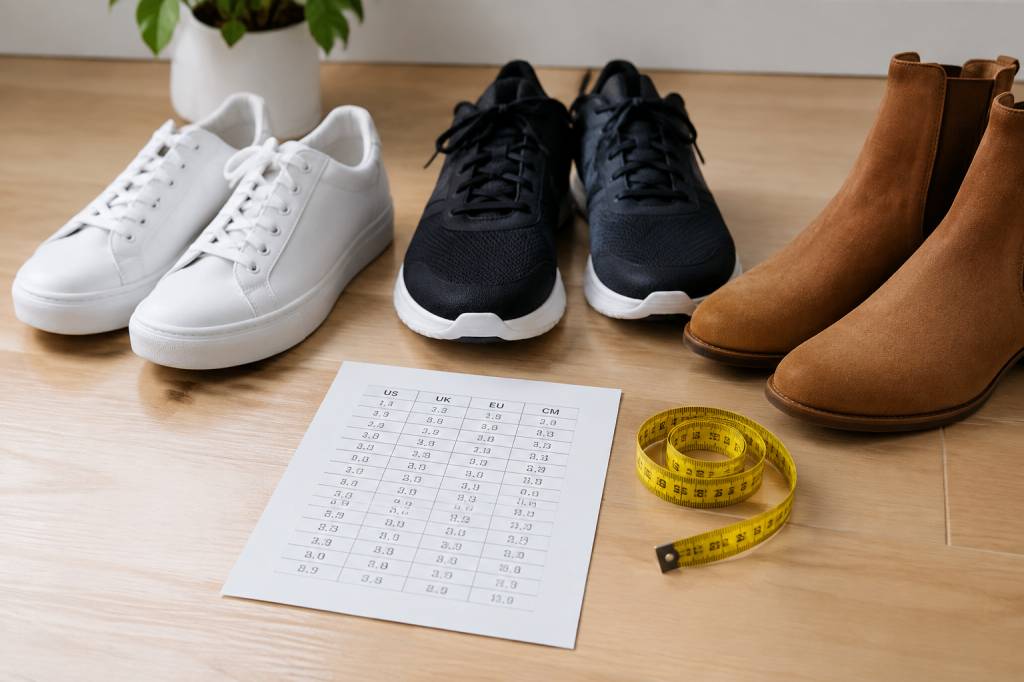
Working out what a 10.5 US shoe size converts to in the UK sounds simple, but there is one important detail to check first: are you looking at a men’s or women’s shoe size? US sizing uses different scales, so the same number does not always translate to the same UK size.
For most footwear, a US men’s 10.5 is approximately a UK 9.5, while a US women’s 10.5 is approximately a UK 8.5. However, sizing can vary between brands, shoe types and even individual models. Use this guide to find the closest UK equivalent, understand fit differences and choose the right footwear for work, walking, running, travel and outdoor use.
Quick US 10.5 to UK shoe size conversion
The table below gives the most commonly used conversions. Treat these figures as a reliable starting point rather than an absolute rule, particularly when buying online.
- US men’s 10.5: approximately UK 9.5
- US women’s 10.5: approximately UK 8.5
- US children’s 10.5: a completely different scale, usually around UK 9.5 child sizing
- US men’s 10.5 in EU sizing: approximately EU 44
- US women’s 10.5 in EU sizing: approximately EU 41.5–42
The most important point is to check whether the listing refers to men’s, women’s or unisex sizing. A US 10.5 on a men’s trainer page should not automatically be converted using a women’s size chart.
Is a US men’s 10.5 the same as a UK 9.5?
In most standard size charts, yes. A US men’s 10.5 is generally equivalent to a UK 9.5. This conversion works well for many trainers, casual shoes, walking boots and formal footwear.
The difference between US and UK men’s sizing is usually one full size. For example, a US men’s 9 is commonly a UK 8, a US 10 is a UK 9, and a US 10.5 is a UK 9.5.
There are exceptions. Some brands use half-size differences, rounded conversions or their own internal measurements. A brand may list a US 10.5 as a UK 10, especially if the shoe is designed with a generous fit. This is why the brand’s official chart should take priority over a general conversion table.
Is a US women’s 10.5 the same as a UK 8.5?
Usually, a US women’s 10.5 converts to a UK 8.5. Women’s sizing follows a different scale from men’s sizing, so it is not correct to convert a women’s US 10.5 to a UK 9.5 simply because the number is the same.
Women’s shoes may also be narrower through the heel or forefoot than men’s versions. Some brands offer standard, wide and extra-wide widths, while others use a single width for the entire range. If you often feel pressure across the toes, the issue may be width rather than length.
For unisex styles, the product page may show men’s US sizing first. A unisex US men’s 10.5 could therefore be close to a UK 9.5, while the equivalent women’s size may be listed as US 12 or UK 9.5, depending on the brand.
US 10.5 to UK conversion chart
Here is a practical reference for nearby sizes. It is particularly useful when comparing several pairs on a shopping site.
- US men’s 9: UK 8
- US men’s 9.5: UK 8.5
- US men’s 10: UK 9
- US men’s 10.5: UK 9.5
- US men’s 11: UK 10
- US women’s 9: UK 7
- US women’s 9.5: UK 7.5
- US women’s 10: UK 8
- US women’s 10.5: UK 8.5
- US women’s 11: UK 9
These conversions are based on common industry standards. They should not replace a measurement in centimetres or the manufacturer’s own fit guide.
How to check your foot length before ordering
If you are between sizes, measuring your feet is often more useful than relying on a familiar label. Feet can also be slightly different sizes, so measure both and use the longer foot when choosing footwear.
- Place a sheet of paper on a hard floor and stand on it wearing the socks you expect to use.
- Keep your heel lightly against a wall and distribute your weight evenly.
- Mark the end of your longest toe. This may not be your big toe.
- Measure from the edge of the paper to the mark in centimetres.
- Repeat the process for the other foot.
- Compare the larger measurement with the shoe brand’s size chart.
Measure at the end of the day if possible. Feet naturally swell after walking and standing, and a pair that feels perfect first thing in the morning may feel tight after several hours of use. This matters particularly for running shoes, hiking boots and work footwear.
What fit should you expect from a UK 9.5?
A UK 9.5 should provide enough room for your toes to spread without allowing your heel to lift excessively. Your longest toe should sit roughly 1 cm from the front of a walking or running shoe. Formal shoes may have a little less room, but your toes should never feel compressed.
Try the following checks when your shoes arrive:
- Your toes should be able to move without touching the front of the shoe.
- The widest part of your foot should sit comfortably within the widest part of the shoe.
- Your heel should remain secure when walking upstairs or on an incline.
- The upper should not create pressure points across the instep.
- There should be no rubbing around the ankle or Achilles tendon.
A shoe can be the correct length and still be the wrong fit. Width, cushioning, heel shape and the stiffness of the upper all influence comfort.
Best footwear picks for a US men’s 10.5 or UK 9.5
Once you know the conversion, the next question is what type of shoe suits your routine. These are practical footwear categories to consider when shopping in the UK.
Everyday trainers
For daily commuting, errands and casual outfits, choose a trainer with moderate cushioning and a breathable upper. A neutral design in black, white or grey is easy to pair with jeans, chinos and activewear.
Look for a removable insole, particularly if you use orthotics or prefer extra arch support. A rubber outsole with a textured tread is also more useful than a smooth fashion sole when British pavements are wet.
Popular everyday trainer ranges from brands such as New Balance, adidas, Nike and ASICS often include half sizes and multiple width options. That makes them a sensible starting point if a standard UK 9.5 has felt too narrow in the past.
Running shoes
Running shoes should be selected according to your running habits, not just their appearance. A lightweight road-running shoe is suitable for pavements and treadmills, while a trail model offers a more aggressive outsole for mud, gravel and uneven paths.
For a US men’s 10.5 converted to UK 9.5, compare the internal length in centimetres. Running shoes commonly need a little more space than lifestyle trainers because feet expand during longer sessions. If your toes touch the front when walking, the shoe is unlikely to be comfortable on a five-mile run.
Useful features include breathable mesh, a secure heel counter, responsive foam and a durable outsole. Models from ASICS, Brooks, Saucony, Hoka and adidas are frequently available in a broad selection of sizes, although the best choice depends on your preferred cushioning and running surface.
Walking shoes and hiking boots
For country walks and weekend hikes, prioritise grip, support and weather resistance. A low-cut walking shoe is flexible and convenient for parks or well-maintained trails. Hiking boots provide more ankle coverage and protection on rocky or uneven ground.
If you plan to wear thick hiking socks, try the shoes with those socks rather than thin everyday ones. Waterproof membranes can also make footwear feel less flexible, so a slightly roomier toe box may be preferable.
Look for a lugged outsole, reinforced toe area and a heel that stays stable on descents. Brands such as Merrell, Salomon, Columbia and The North Face offer walking footwear across several fit profiles. Remember that a UK 9.5 in a lightweight trainer may not feel identical to a UK 9.5 in a structured hiking boot.
Smart-casual and office shoes
For office wear, a leather trainer, derby shoe or minimalist loafer can provide a smarter alternative to a sports shoe. A UK 9.5 may feel different across these styles because leather uppers often soften with wear, while synthetic materials tend to keep their original shape.
Choose a secure fastening if you need all-day comfort. Lace-up derbies offer more adjustability than slip-on loafers, especially if your feet swell during the working day. A cushioned footbed and flexible sole can also make a noticeable difference when commuting on foot.
For formal shoes, do not size up automatically because the toe shape looks narrow. A longer shoe will not solve a width problem and may cause heel movement. Look for wide-fit options instead.
Travel shoes
The best travel shoes combine comfort, low weight and easy maintenance. A flexible trainer or slip-on can be useful for airport security and long days of sightseeing, while a water-resistant upper is helpful in unpredictable weather.
For city breaks, avoid buying a brand-new pair immediately before departure. Wear them around the house first and test them on short walks. This is one situation where a small fit problem can quickly become a very large inconvenience.
Women’s footwear picks for a US 10.5 or UK 8.5
If you are converting a women’s US 10.5 to a UK 8.5, the same fit principles apply, but it is worth paying close attention to width and heel security.
For everyday wear, cushioned trainers with a padded collar can reduce rubbing during commuting. For work, block-heel shoes and supportive loafers are generally more practical than very rigid pointed styles. For outdoor use, choose a walking shoe with a stable outsole and enough space for hiking socks.
Brands including New Balance, Skechers, adidas, Nike, ASICS and Clarks often provide useful women’s size ranges. Some models also include wide-fit versions, which are worth considering if your toes feel squeezed even when the length is correct.
Common sizing mistakes to avoid
- Assuming every US 10.5 converts the same way: always identify the men’s, women’s or children’s size scale.
- Ignoring the brand chart: manufacturer measurements are more precise than a generic online calculator.
- Choosing based only on EU size: EU sizing is not perfectly standardised either.
- Measuring one foot only: use the measurement of your longer foot.
- Buying running shoes too snug: allow enough room for natural swelling and toe movement.
- Forgetting socks: thick hiking socks can change the fit considerably.
- Assuming wider means longer: width and length are separate measurements.
What to do if you are between UK sizes
If your measurement falls between a UK 9 and UK 9.5, the right decision depends on the shoe type. A casual leather shoe may work in the smaller size if the upper is soft and the fit is generous. A running shoe or hiking boot will usually benefit from the extra room, particularly if you wear thicker socks.
Check whether the retailer offers free returns and order two sizes if the policy allows it. Try both pairs indoors on a clean floor, preferably later in the day. Walk, bend your toes and test the heel hold before removing the labels or wearing them outside.
The most dependable approach is to combine three details: your usual UK size, your foot measurement in centimetres and the product-specific size chart. For a US men’s 10.5, start with UK 9.5. For a US women’s 10.5, start with UK 8.5. Then use the shoe’s measurements and return policy to make the final decision.