
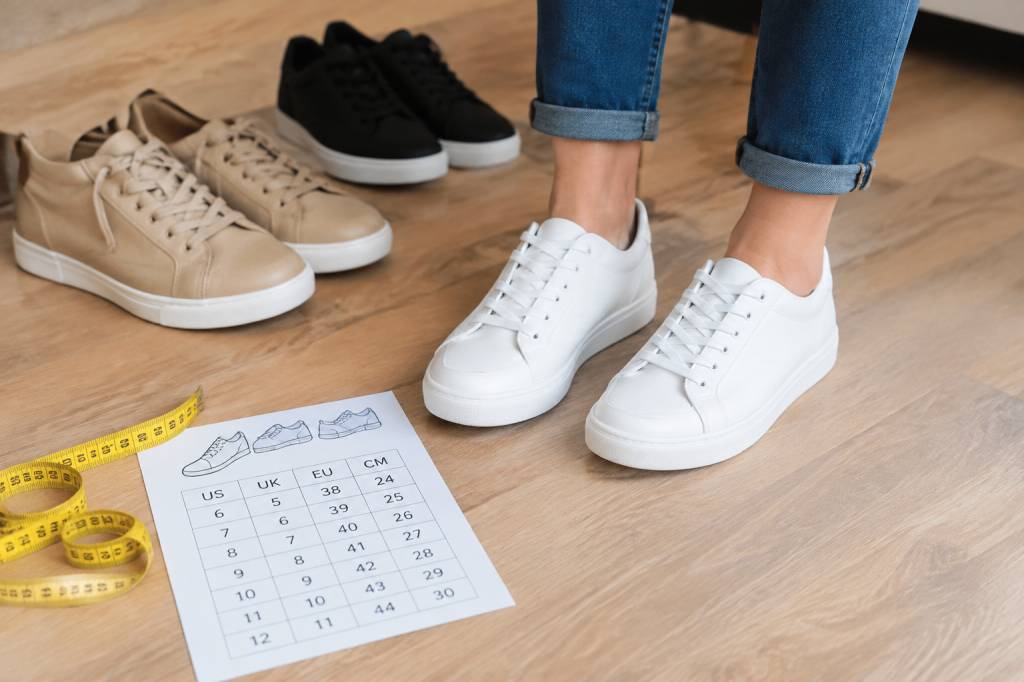
Finding the right shoe size can feel surprisingly complicated, especially when shopping across the UK and Europe. A UK size 11 does not always translate into exactly the same European size from one brand to another, and factors such as foot width, shoe shape and materials can all affect the fit.
If you usually wear a UK size 11, the European equivalent is generally around EU 45 or EU 46. That simple conversion is a useful starting point, but it should not be the only thing you check before placing an order. Shoe sizing is not completely standardised, so a few extra minutes with a size chart can save you from an uncomfortable pair and the hassle of a return.
What is a UK size 11 in European sizing?
For most men’s footwear, a UK size 11 corresponds approximately to EU size 45 or 46. Many brands list UK 11 as EU 45, while others use EU 46. Sports footwear brands often lean towards EU 46, particularly in trainers designed with a little extra room.
Here is a general guide:
- UK 11: approximately EU 45–46
- UK 11: approximately US men’s 12
- UK 11: approximately 29–30 cm foot length
These measurements are estimates rather than universal rules. For example, one brand’s EU 45 may feel similar to another brand’s EU 46. Even two pairs from the same manufacturer can fit differently if one is a running shoe and the other is a formal leather style.
It is also worth checking whether the retailer is showing UK, US or EU sizing. A “size 11” on an American website usually refers to a US men’s size, which is generally smaller than a UK 11. A US men’s 11 is often close to a UK 10, although, once again, brand charts can vary.
Why shoe size conversions are not always exact
Shoe sizes are based on different measurement systems. UK sizing traditionally uses barleycorn increments, while European sizing is based on the Paris point system. They do not match perfectly, which is why conversion charts offer an approximation rather than a precise mathematical answer.
Manufacturers also make their own decisions about how much space to build into a shoe. A walking boot may have a generous fit to accommodate thicker socks, while a smart loafer may be cut closer to the foot. A football boot is often designed to feel snug for control, whereas a running shoe normally needs extra room around the toes.
Then there is the shape of the shoe itself. A long, narrow dress shoe may feel tight even when the length is correct. A wide trainer could feel comfortable in the same nominal size. In other words, the number on the box is only one part of the fitting story.
How to measure your feet at home
Measuring your feet is one of the most reliable ways to choose the right size online. You do not need specialist equipment; a sheet of paper, a pencil, a ruler and the socks you plan to wear with the shoes will do the job.
- Place a sheet of paper on a hard floor, with one edge against a wall.
- Stand on the paper with your heel lightly touching the wall.
- Ask someone to mark the tip of your longest toe. Do not trace around your foot while sitting, as this can produce a smaller measurement.
- Measure the distance from the edge of the paper to the mark in centimetres.
- Repeat the process for the other foot.
- Use the measurement of your larger foot when checking the brand’s size chart.
Most people have one foot slightly larger than the other. This is completely normal. If the difference is noticeable, choose footwear that fits the larger foot and use an insole or a small heel grip to improve the fit on the other side.
Measure your feet later in the day if possible. Feet can swell after walking and standing, so an evening measurement may give a more realistic result than one taken first thing in the morning. It is a small detail, but it can make a surprisingly big difference.
Understanding foot length for a UK size 11
A UK size 11 commonly suits a foot length of roughly 29 to 30 centimetres. However, the measurement shown on a size chart may refer to the length of the foot or the internal length of the shoe. These are not the same thing.
Your shoe needs a little extra space beyond the end of your longest toe. For everyday footwear, around 10 to 15 millimetres of space is usually comfortable. Running shoes and hiking footwear may require slightly more, especially if your feet swell during activity or you wear thick socks.
Do not choose a size simply because the centimetre figure appears to match the length of the shoe. Check the wording carefully. If a chart says “foot length”, compare it directly with your measurement. If it says “insole length” or “shoe length”, the figure may include the space inside the toe box and should not be interpreted in the same way.
Men’s and women’s size 11: an important difference
When people search for a size 11 shoe in Europe, they are usually referring to a UK men’s size 11. Women’s sizing can be different, and a UK women’s 11 may convert to a different European size depending on the brand and the style.
Some retailers use a shared unisex chart, while others publish separate men’s and women’s measurements. Women’s shoes are also often designed with a narrower heel and a different shape across the forefoot. A direct conversion based only on the number may therefore lead to the wrong fit.
Always check whether the product page specifies men’s, women’s or unisex sizing. This is especially important when buying trainers, boots or fashion footwear from international websites, where the size label may not make the target market obvious.
Choosing the right width
Length is only half the fitting equation. If your feet are broad, a correctly converted UK 11 can still feel uncomfortable if the shoe has a narrow design.
Width labels vary between brands, but you may see terms such as standard, wide, extra wide, D, E, EE or 2E. The meaning is not identical across every manufacturer. In many men’s ranges, a D width is considered standard, while E or EE offers more room. Some European brands use descriptive terms instead of letters.
Look for signs that a shoe may be too narrow:
- Your little toe rubs against the side of the shoe.
- The upper bulges over the sole when you stand.
- Your toes feel compressed even though there is enough length.
- You develop pressure points or numbness after a short walk.
A wider shoe is not automatically better. Excess space can allow your foot to slide, creating friction and blisters. The aim is a secure fit across the midfoot, with enough room for your toes to spread naturally.
How different shoe styles affect your size choice
The best size for a UK 11 will depend partly on the type of footwear you are buying. A flexible trainer may feel comfortable with a little room, while a structured leather shoe may need a more precise fit.
Trainers: Choose a shape that leaves roughly a thumb’s width between your longest toe and the front of the shoe. Running shoes often need more room than casual trainers because feet expand during exercise.
Walking boots: Try them with the socks you normally wear outdoors. Your heel should remain stable, and your toes should not touch the front when walking downhill. If you are between sizes, check whether the brand offers half sizes rather than automatically moving up a full size.
Formal shoes: Leather shoes can soften and mould slightly with wear, but they should not feel painfully tight when new. Do not rely on a “breaking-in” period to fix pressure across the toes.
Football and court shoes: These styles often have a closer fit for movement and control. Even so, your toes should not be curled or pressed against the front. Performance should never require discomfort.
Sandals: Check that your heel and toes remain fully supported by the footbed. A sandal that is technically the right length can still feel unstable if the straps sit in the wrong place.
Common mistakes when buying EU size 45 or 46
One of the most common mistakes is assuming that EU 45 is always a UK 11. It may be correct for one brand and too small for another. The same applies to EU 46, which could be perfect in a trainer but too roomy in a slim loafer.
Another mistake is measuring only one foot. The larger foot should guide your choice, particularly when buying stiff footwear that does not stretch much. Shopping based on your usual size without checking the product page can also be risky, especially with unfamiliar brands.
Some shoppers order a larger size to gain width. This can create new problems: the heel slips, the foot moves inside the shoe and the toes may still feel crowded if the design is narrow. A wide-fit version is usually a better solution than simply increasing the length.
Finally, avoid judging fit while sitting down. Stand, walk and bend your knees. Shoes can feel perfectly fine for a few seconds in a chair but become uncomfortable after ten minutes on your feet.
Buying size 11 shoes online in Europe
Online shopping gives you access to a far wider selection, but it also makes careful checking essential. Before ordering, look for the brand’s own conversion table rather than relying only on the retailer’s general chart.
- Confirm that the listed size is UK, EU or US sizing.
- Check the recommended foot length in centimetres.
- Look for width information and reviews mentioning whether the shoes run narrow, wide, small or large.
- Read the returns policy, including return postage and the time allowed for exchanges.
- Check whether the product is sold directly by the retailer or by a marketplace partner.
Customer reviews can be particularly helpful when several people mention the same issue. “True to size” is useful, but comments such as “roomy in the toe box” or “narrow across the midfoot” provide much more practical information.
When your new shoes arrive, try them indoors on a clean floor. Wear the socks you expect to use and test both shoes. Walk up and down, stand still and check the fit at the end of the day. This gives you a better chance of returning them in perfect condition if they are not right.
When to choose EU 45 and when to choose EU 46
As a broad guide, EU 45 may suit a UK 11 in brands that use a generous or longer fit, while EU 46 is often the safer option in sports and outdoor ranges that use a roomier size structure. But your measured foot length and the brand’s own chart should take priority.
If your foot measures near the upper end of the brand’s recommended range, consider EU 46, particularly for walking shoes, boots or trainers. If you are near the lower end and the style is roomy, EU 45 may provide better control. Half sizes, where available, are ideal for fine-tuning the fit.
Remember that a little space at the front is healthy; heel movement and pressure across the toes are not. The perfect pair should feel secure without squeezing, supportive without being rigid and comfortable enough that you stop thinking about your feet after putting them on. That is usually the best sign that your UK size 11 has found its European match.