
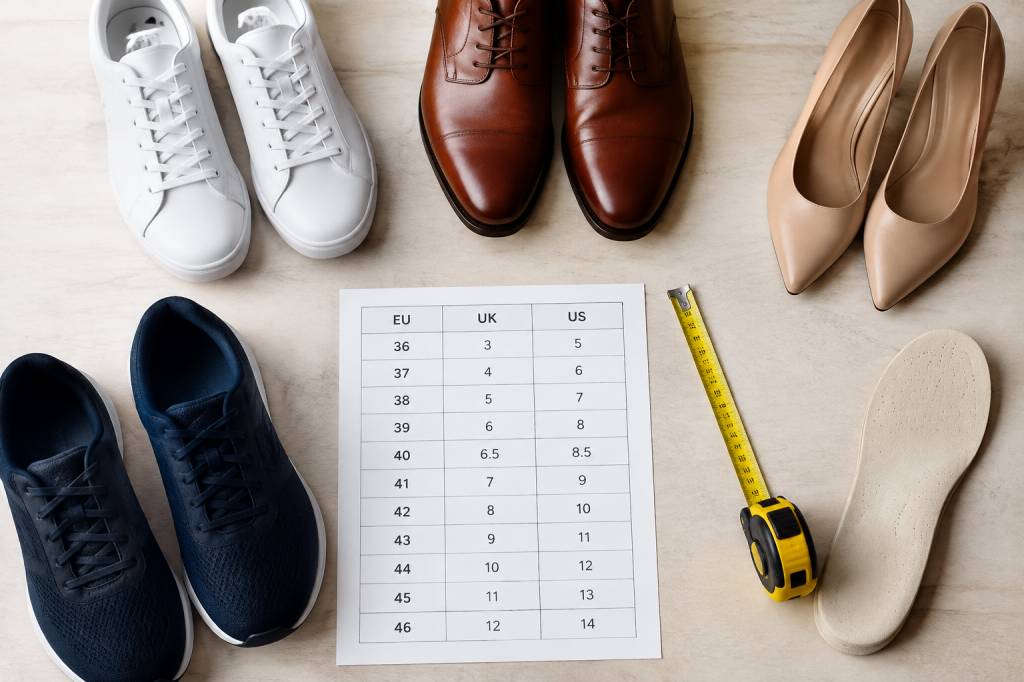
Shopping for size 12 shoes can be surprisingly confusing. A UK size 12 does not always translate to one fixed European size, and the answer may change depending on the brand, shoe type and whether you are buying men’s or women’s footwear. Add different width fittings and international sizing charts, and a quick online purchase can become a guessing game.
This practical UK to EU shoe size guide explains what a UK size 12 usually means in European sizing, how to measure your feet accurately and which types of shoes are worth considering. Whether you are looking for trainers, walking boots, formal shoes or everyday footwear, the right conversion is only the starting point.
What is a UK size 12 in European sizing?
A UK men’s size 12 is usually equivalent to an EU size 46 or 47. Most brands list it as EU 46, but some trainers, boots and wider-fit shoes may use EU 47. The difference comes from the fact that UK and EU sizing systems are based on different measurements.
- UK men’s size 12: commonly EU 46–47
- Approximate foot length: around 29.5–30 cm
- US men’s equivalent: usually US 13
- Typical UK width options: standard, wide or extra wide, depending on the brand
It is important not to treat this as an exact mathematical conversion. A size 12 from one manufacturer may feel shorter or narrower than a size 12 from another. This is particularly noticeable with running shoes, leather dress shoes and outdoor boots, where the shape of the toe box can vary considerably.
UK to EU shoe size conversion chart
The chart below is a useful starting point for adult men’s footwear. Always check the brand’s own sizing guide before ordering, especially when buying online.
- UK 8: EU 42
- UK 9: EU 43
- UK 10: EU 44–45
- UK 11: EU 45–46
- UK 12: EU 46–47
- UK 13: EU 47–48
- UK 14: EU 48–49
For a women’s UK size 12, the EU equivalent can be very different because women’s shoe ranges often use a separate conversion scale. It is commonly listed around EU 45 or EU 46, but large-size women’s collections vary significantly. If you are buying women’s footwear in a UK 12, use the individual retailer’s chart rather than converting from a men’s size.
Why a UK size 12 may be EU 46 or EU 47
UK shoe sizes are based on a traditional barleycorn system, while EU sizes use Paris points. One EU size represents approximately 6.67 mm of length. Neither system perfectly describes the interior space of a shoe, however, because the final fit also depends on the shoe’s internal shape, materials and construction.
A formal leather shoe may have a narrow, structured toe box. A running trainer may include extra room at the front to allow your feet to expand during exercise. A hiking boot may feel smaller once thick walking socks are added. All three could be labelled UK 12, yet fit completely differently.
Some brands also round their conversions differently. One may describe UK 12 as EU 46, while another recommends EU 47. This is not necessarily an error. It may reflect a different last, a wider fit or a slightly different interpretation of foot length.
How to measure your feet before ordering
Measuring your feet is more reliable than relying on a conversion chart alone. You will need a sheet of paper, a pencil, a ruler or tape measure and the socks you expect to wear with the shoes.
- Place the paper on a hard, flat floor rather than a soft carpet.
- Stand with your heel lightly touching a wall.
- Ask someone to mark the furthest point of your longest toe.
- Measure from the edge of the paper to the mark in centimetres.
- Repeat the process for the other foot.
- Use the measurement of your larger foot when checking the brand’s chart.
Feet are rarely identical. It is common for one foot to be slightly longer or wider than the other, so choosing footwear for the smaller foot can lead to uncomfortable pressure. Measure at the end of the day if possible, when feet are naturally at their largest.
For many UK size 12 shoppers, a foot length close to 30 cm points towards EU 46 or EU 47. However, do not automatically choose the larger size simply because it sounds safer. Excess space can cause heel slip, rubbing and poor stability. The best fit should leave a small amount of room in front of the longest toe without allowing the foot to move excessively inside the shoe.
Best size 12 shoe picks by purpose
The best shoe depends on how you plan to use it. Rather than choosing by appearance alone, consider cushioning, support, width, materials and the type of socks you normally wear.
Everyday trainers
For commuting, errands and casual wear, look for a trainer with a rounded toe box, breathable upper and a removable or cushioned insole. A flexible sole is comfortable for daily walking, while a secure lace system helps prevent movement in a larger shoe.
Size 12 shoppers should pay close attention to the forefoot. Some fashion trainers are long enough but narrow across the toes. If the brand offers a wide or extra-wide version, it can be a better choice than sizing up. Going up to EU 47 may create unwanted heel movement if the main issue is width rather than length.
Running shoes
Running shoes are often one of the easiest places to find extended sizes, but the correct fit is especially important. Your feet can swell during a run, and your toes need enough room to spread naturally. Many runners choose around half a size more room than they would in a formal shoe, although this should not mean a loose heel.
- Look for a thumb’s width of space between the longest toe and the front of the shoe.
- Check that the heel stays secure when walking and jogging.
- Choose the width fitting separately from the length.
- Try shoes with the socks you use for training.
- Do not assume the same size works across every running brand.
A well-cushioned trainer is a sensible pick for everyday walking too, but avoid choosing a performance shoe purely because it looks sporty. Some running models have aggressive soles or highly structured cushioning that may feel unnecessary for casual use.
Walking shoes and hiking boots
For countryside walks, waterproof walking shoes and hiking boots, prioritise grip, ankle support and internal volume. A boot should accommodate walking socks without compressing the toes. If you are between EU 46 and EU 47, compare the brand’s foot-length measurement and consider whether the model is designed for thick socks.
Hiking boots should feel secure on descents. If your toes touch the front when walking downhill, the boot is too short or the heel is not being held firmly enough. A padded collar and a reliable lacing system can make a major difference on longer walks.
For occasional park walks, a low-cut waterproof walking shoe may be more comfortable and versatile than a full boot. For uneven trails or heavier packs, choose a model with a more supportive midsole and deeper outsole tread.
Smart-casual and formal shoes
Leather loafers, brogues and smart lace-up shoes often have a more structured fit than trainers. Start with the EU size recommended by the manufacturer, then check the shoe width and toe shape. A pointed toe can feel restrictive even when the length is technically correct.
For office footwear, look for a cushioned footbed, breathable lining and a rubber or leather sole with enough grip for wet pavements. A lace-up style usually offers more adjustability than a slip-on, particularly if your feet vary in volume during the day.
Do not rely on the idea that leather shoes will always stretch enough to fix a poor fit. Leather can soften, but it will not reliably add length. If your toes are pressing against the front, choose a different size or shape rather than hoping the shoe will adapt.
Work and safety footwear
If you need size 12 work boots, check the safety certification, toe-cap design and sole rating before focusing on colour or price. Steel and composite toe caps can affect the amount of space available inside the shoe, so compare internal fit carefully.
- Choose a safety rating suitable for your workplace.
- Check whether the boot is oil-resistant, slip-resistant or waterproof.
- Allow room for work socks without creating heel slip.
- Look for a padded tongue and ankle support for long shifts.
- Confirm the retailer’s returns policy before wearing the boots outdoors.
Width matters as much as length
Many fit problems blamed on shoe size are actually width problems. A shoe can be long enough but still press across the ball of the foot. Conversely, a wide shoe may feel comfortable at the front while slipping at the heel.
Brand width labels are not completely standardised, but you may see terms such as standard, wide, extra wide, 2E or 4E. Check how each retailer defines these labels. Some brands use letters, while others use descriptive names.
If your feet are wide, look for adjustable laces, stretch panels, rounder toe boxes and removable insoles. Avoid forcing your feet into a narrow shoe and assuming that sizing up will solve the problem. More length does not always provide more useful width.
Common online shopping mistakes with size 12 footwear
The most common mistake is choosing EU 46 automatically because it appears beside UK 12 on a general chart. A second is ignoring the product-specific chart. Brand sizing pages often provide foot length in centimetres, which is usually more useful than a simple UK-to-EU table.
- Do not compare only the printed size; compare the foot-length recommendation.
- Do not measure your feet while sitting, as standing gives a more accurate result.
- Do not order based on your old size if the new pair uses a different brand or style.
- Do not forget to check whether the listing is men’s, women’s or unisex sizing.
- Do not remove tags or wear shoes outside until you are sure about the fit.
It is also worth checking customer reviews for useful details. Comments such as “runs narrow”, “true to length” or “size up for hiking socks” can reveal information that a product page may not mention. Look for repeated patterns rather than relying on one review.
How to order size 12 shoes with less risk
Before adding a pair to your basket, record your larger foot measurement in centimetres. Compare it with the manufacturer’s chart, then check the width options and return conditions. If the retailer offers free returns or exchanges, ordering two adjacent sizes can be practical, provided you can return the unsuitable pair easily.
When the shoes arrive, try them indoors on a clean floor. Wear the socks you plan to use and walk for several minutes. Check for pressure at the toes, rubbing around the heel and tightness across the widest part of the foot. A correctly fitted shoe should feel secure without requiring a break-in period that involves pain.
For a men’s UK size 12, EU 46 is often the first size to try, while EU 47 may be more suitable for brands that run short or for footwear designed around thicker socks. The right choice is ultimately the one that matches your measured foot length, required width and intended use.
With a careful measurement and a product-specific sizing chart, finding size 12 shoes becomes far less complicated. Whether you are choosing everyday trainers, waterproof hiking boots or smart office shoes, focus on fit details rather than the number printed inside the box.